General

  • What happens when the artist died before 1st of December 2024?

    When the artist has died before the commencement of the Act, it is not their will that determines who succeeds the resale right – but rather NZ intestacy legislation.   This is required by Section 2 of Schedule 1 of the Act (transitional provisions).       
    In other words, the artists resale right will be passed to one or more successors “as if” they died intestate (i.e. left no will).  

    How to Apply Intestacy Rules 

    The relevant intestacy rules to be applied are set out in the Administration Act 1969, in particular Part 3 (sections 75-80).   

     Specifically – answers can be found by applying the table at section 77, in two steps:  

    • First, look at the left-hand column, and select the most accurate description of who were actually left behind by the deceased (e.g. spouse, children, parents etc).   
    • Second, based on the correct selection, the second column tells us how the estate (and Resale Right) is to be distributed between that person or people.  

    Example

    1. First, looking at the left-hand column of section 77, identify the correct class of people.   Choose the one which most accurately describes who actually survived the deceased (e.g. spouse, children, parents etc).   This could be one of 8 different combinations, for example: did the deceased leave behind:
    • a surviving partner (husband, wife, de facto) but no children (example numbered “1”);  versus  
    • a surviving partner, and children (example numbered “2”);  versus   
    • a surviving partner, no children, but one or both parents (exampled numbered “3”); versus  
    • no surviving partner, but children and parents (example numbered “4”); 
    • etc. 
    1. Once we’ve identified which of the 8 combinations applies, see the second column for how the estate is divided. 

    Let’s assume that the artist was survived by:  1 spouse, and 2 children.  Looking at the left-hand column of section 77, this matches the example numbered “2”.   Based on this selection, the right-hand column states that the beneficiaries to the estate residue are 1/3 to the spouse, and 2/3 to the two children (in equal shares). 

    Note:  if one of the successors subsequently dies, then their share will pass to their own successors (either under their will, or if they died before the Act then applying the same rules above. 

    Distributing the Resale Royalty 

    To claim your share of a resale royalty each successor will need to register with RRA here

    When registering, you will need to confirm your identity and your share of the resale royalty as per the intestacy law. 

    When more than one successor claims a share in the resale royalty, we may need to verify each person’s respective share before making a distribution.  This is explained further in paragraph 11 of RRA’s Distribution Policy. 

    In plain English terms: 

    Who inherits the artist’s resale right? 

    • The artist died before the 1stDecember 2024, it is determined by the New Zealand intestacy law.
    • The artist died after the 1st December 2024, it can be determined by the artist’s will.

    Why is the will not recognised when they died before the 1st of December 2024? Resale Right for Visual Artists Act states that when the artist died before the Act started then the intestacy law applies because the resale right did not exist before then.

    How do I work out my share of the resale right?

    1. Identify your situation: Look at the descriptions on the left-hand column to match your situation. Refer to section 77,

    2. Determine the distribution: The right-hand column for that selection then tells you how the resale right is to be shared. 

    Here is an example:  

    If you are the child of an artist who was survived by a partner and two children, Section 77 would indicate the partner gets 1/3 and the children get 2/3 (split equally between them). You would then get 1/3 of the resale right royalties.

    Note: In the Administration Act 1969, “issue” refers to a person’s direct decedents including children, grandchildren etc.

    What happens to my share of the resale right if I die? Your inherited share of the resale right will pass on to your own successors as per your will, or if there is no will then the intestacy law is applied.

    Questions? Please contact us at kiaora@resaleroyalties.co.nz
  • Is a Resale Royalty applicable to artworks sold at a charity auction?

    Yes, a qualifying resale of an original artwork sold as part of a charity auction is still subject to the artist’s resale royalty right. While the auction house or vendor may choose to waive their own fees or commission as a business decision, this does not exempt the resale from the artist’s entitlement under the Resale Royalty Scheme.


    However, an artist may choose to decline to receive payment of all or part of a resale royalty, in which cases RRA will collect and manage the royalty in accordance with the statutory Regulations. These anticipate that the amount will be transferred to a Cultural Fund for the purposes of supporting the career sustainability of visual artists. Updates about the Cultural Fund can be found here.


    For any feedback or policy inquiries regarding this matter, please direct your correspondence to the Ministry for Culture and Heritage (MCH). Their contact details can be found within our complaints policy document, accessible here: Complaints Policy

  • What is a “Resale” and how does this apply to gifted or inherited artworks?

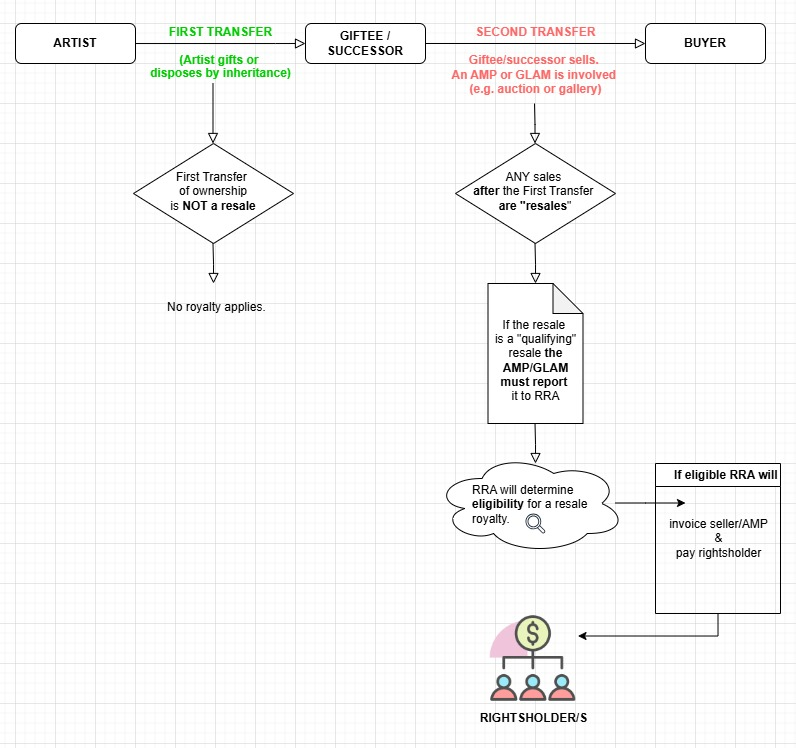
    Resale means any sale after the first transfer of ownership (whether for consideration or not).

    The scheme therefore applies to all sales after the first transfer of ownership.

    How does this apply to sales of gifted or inherited artworks?

    Explained in the context of a sale of gifted and/or inherited artwork, that means:

    1. When the artwork is gifted by the artist, or inherited from the artist:
      • This qualifies as the “first transfer of ownership”.  This means the first transfer does not count as a “resale”.
    2. However, when the giftee or successor subsequently sells the artwork:
      • This is a sale after the first transfer of ownership.  This means it is a “resale”.
      • This means the scheme applies to the resale.  If an AMP or GLAM is involved in this resale, and the resale is over $2,000, then it must be reported to RRA as a “qualifying resale”.

    For a visual representation please see the flowchart below:

  • How do I update my details?

    To update personal information and contact details, you can log into the RRA portal and make changes. To update declarations or any other information, please email us at kiaora@resaleroyalties.co.nz

  • How much is the resale royalty payment?

    The amount is the same for both eligible artists and successors, a 5% royalty will be collected for eligible artists each time there is a qualifying resale of their original visual artwork. 

    The collection and distribution of the payment is managed by RRA, a not-for-profit. RRA will retain 20% for the purpose of funding RRA operations and distribute the remainder of the royalty to the visual artist or successor.

  • What is an “original visual artwork”?

    Checklist 2.1:  If any of the following boxes are checked, the work is a “visual artwork”:  

    • cultural expressions of Māori or Pacific peoples;
    • painting, drawing, carving, engraving, etching, lithography, woodcutting, printing (including a book of prints);
    • sculpture, collage, modelling;
    • craftwork, ceramics, glassware, jewellery, textiles, weaving, metalware, furniture;
    • photography or video art;
    • multimedia art;
    • art created using computers or other electronic devices;
    • ethnic or cultural art that is a variation of any type of work described above in the 2nd through final bullets.

    However, visual artwork does not include:

    • a building*;
    • a dramatic work* or musical work*;
    • a literary work*, unless it is a compilation that includes a visual artwork.

    * (These terms are defined in s 2(1) of the Copyright Act 1993)

    Checklist 2.2: To be an “original”, the visual artwork must have been:

    • Created by, or under the authority of, the artist; or
    • One of a limited number of copies of visual artwork made by that artist or under their authority.

  • Who is liable to pay the resale royalty?

    The following persons are jointly and severally liable to pay the 5% resale royalty to RRA (section 17, of the Act) :

    • The seller, and either
      • the agent acting for the seller on the resale (usually the AMP); or
      • if the seller does not have an agent, the agent acting for the buyer on the resale; or
      • if there are no agents, the buyer.

  • When is a resale royalty payable?

    An eligible artist” (or their successor) has a right to be paid a resale royalty each time there is a “qualifying resale” of an “original visual artwork” by that artist (provided the resale right had not “expired” at the time of resale)

     Use the flowchart in the Criteria section of the Homepage to apply this test in 4 Steps.

  • RRA policy on non-compliance

    If a liable person fails to pay a resale royalty, or fails to provide the required reporting information, or if any other requirement of the Act is not complied with, then the Act provides that the Collection Agency may apply to a court for orders enforcing these obligations, and for any other order that is appropriate for an infringement of a property right.  The Act provides that this does not limit any other proceeding that may otherwise be taken by the Collection Agency, a right holder, or any other person affected.  Nor does it limit any other power of the court.  

  • How will the scheme work for galleries who often buy at auction to re-sell? Will the royalty be payable twice?

    A royalty is payable on each resale.  

    Who is liable in each instance is answered by section 17 of the Act.  The seller is always liable, and generally their agent will be jointly and severally liable.  Generally a buyer won’t be liable unless no agent is involved.  

    To give two contrasting examples:

    Where a gallery buys from an auction house or art consultant (who is acting behalf of a seller), the liable parties will be the seller and the seller’s agent (i.e. auction house or art consultant).  It’s unlikely the purchasing gallery would be liable in this scenario (unless the seller actually has no agent, and the buyer has no agent). 

    Where a gallery buys directly from another gallery (without using any agents), then the buying gallery will indeed be jointly liable with the selling gallery to pay the royalty on the purchase.   (How the two galleries share this liability will be a private matter).  The buying gallery will then be liable as a seller if/when they come to resell.  

  • How does it work when an art consultant facilitates a resale between two private parties?

    The resale is considered a professional resale because an art market professional is involved.  That means, provided it meets the standard criteria, it will be a qualifying resale.

  • How is the resale value calculated?

    The resale royalty payable is calculated at 5% of the “resale value” of the qualifying resale (section 16).

    Section 10 says that “resale value” means: “the value of the consideration given for the visual artwork under the contract for resale” which may include:

    • the amount paid in New Zealand dollars;  
    • the value of goods and/or services paid in kind;  
    • (if paid in another currency), the amount converted to NZD at the date of payment.   

    ‘Resale value’ does not include:

    • goods and services tax (GST; or
    • duties, levies, or taxes (etc) under the Customs and Excise Act 2018; or
    • “any costs associated with the resale, for example, a commission or a buyer’s premium” 

    Plain English Guidelines

    In plain English, this means that the “Resale Value” is the amount the buyer has agreed to pay the seller for the artwork itself.   All external and other associated costs (taxes, fees, or levies, etc) are separate to (not part of) the scheme or the Resale Value calculation.  This ensures the value of the royalty relates directly to the value of the artwork itself, and is not subject to other external or variable factors.

    For example:

    An original visual artwork sells at auction.  The sale and purchase agreement records that the buyer will pay $2,000 to the seller as consideration for the artwork (plus any applicable fees and taxes).  

    Under the AMP’s terms of service, the parties agree that the seller will pay the AMP a 20% commission ($400) for acting as its agent, and the buyer will pay the AMP a 15% premium (additional amount) ($300) for facilitating the resale.

    Resale Value

    Assuming the Act applies, in the example given above:

    • The “Resale Value” is $2,000 because, in terms of s 10(1) of the Act, that figure represents the value “given for the visual artwork under the contract for resale”. 
    • In plain English, this is the amount the buyer has agreed to pay the seller “for the artwork”. 
    • The artist is entitled to a 5% share in that Resale Value = $100 in this example.  (The AMP and the seller are jointly and severally liable to pay the $100 royalty to RRA).

    Other Associated Costs:

    Other fees, costs, taxes etc may or may not apply to the sale.  These are, however, separate matters to the value given for the artwork. 

    It is important to distinguish these other transactions from the “Resale Value”.  Note that commissions, premiums, taxes, and other costs are usually separately stated in your legal documents and invoices.  For example, they may appear as separate & distinct line items to the hammer price, within the same invoice (or in separate invoices).  They may appear in the AMP’s terms of service rather than in the contract for resale. 

    A helpful way to distinguish “Resale Value” from “costs associated” is first to ask (1) who is paying whom, and second to ask (2) in respect of what?  For example, “Resale value” is (in plain English) the amount the buyer has agreed to pay the seller, for the artwork.   By contrast:

    • a “buyer’s premium” is, first, an amount the buyer has agreed to pay to the AMP (i.e. not buyer to seller).  It is, second, not given “for the artwork”, but rather for the AMP successfully facilitating the resale. 
    • “commission” is, first, an amount the seller has agreed to pay the AMP (i.e. not buyer to seller).  It is, second, not given as consideration “for the artwork”.  Rather it is given for professional services related to the resale (e.g. marketing, valuation, handling & housing of goods, administration, auctioneering, and other professional services etc). 

  • How does Section 7(3) of the Act relate to “commissioned” artwork?

    Section 7(3) of the Act states “An artist has a right under this section irrespective of whether they are or were the first owner of copyright in the artwork.”

    This means that if the artwork was “commissioned” (as per Section 21(3) of the Copyright Act), then the artist who created the artwork is not the first owner of the copyright, and is still therefore potentially eligible for the artist resale royalty, as long as they are an “Eligible Artist”, the artwork is an “original visual artwork” by the artist, and the resale occurs before the right to receive the ARR has expired (see checklist 4 for more detailed information on when the ARR right expires).

  • What is the duration of the resale right period and will this change with the Copyright Act review?

    Section 15 of the Act states that the duration of the ARR right is 50 years from the end of the calendar year that the (eligible) artist dies, (or if 2 or more artists create the qualifying artwork, then 50 years from the end of the calendar year that the last surviving artist dies). This is the same duration as Copyright under the Copyright Act 1994, which would imply that the ARR is linked to the duration of Copyright however nothing in the legislation confirms this.

  • What are the requirements to report all secondary purchases to RRA, or only those that are a Qualifying Resale under the Act?

    You are only required to report a Qualifying resale as defined in the Act. The scheme will operate on good faith and the belief that you are better qualified to determine whether a purchased item is a qualifying resale or not, and we will not be investigating your decisions unless independently alerted

  • How do you define ‘limited number of copies’? 

    The Act does not define what a limited number of copies is, although there is provision in the Copyright Act that a 3 Dimensional artwork that has fewer than 50 copies produced is copyright protectable, so this might be a useful benchmark. We suggest using good faith best efforts to do your due diligence in researching, and keep a record of your research in case it is needed at a future date.  If you have any concerns or want to discuss then please just get in touch with us. 

  • Would the term to receive a resale royalty for a UK or Australian artist’s work that is a qualifying resale in New Zealand due to our reciprocal agreements be New Zealand’s term of 50 years, or their longer term of 70 years?

    We are applying New Zealand’s legislation but it’s our understanding that this will change in the next few years when the NZ Copyright Act is reviewed.

  • Has there been any consideration regarding the extension of copyright duration that will be enacted sometime in the next four years?

    Currently the artist resale royalty will apply for 50 years after the death of the artist which aligns with New Zealand’s current Copyright Act. However our understanding is that the Copyright term will be extended prior 1 May 2028, and we would expect that the ARR term will then also be extended to align with the Copyright Act.